In August 2025, I visited MIT Media Lab. I arrived interested in engineering; I left with a clearer sense of what I wanted my engineering to do.
01 / MEETING HUGH HERR
A research journey
with a human starting point.
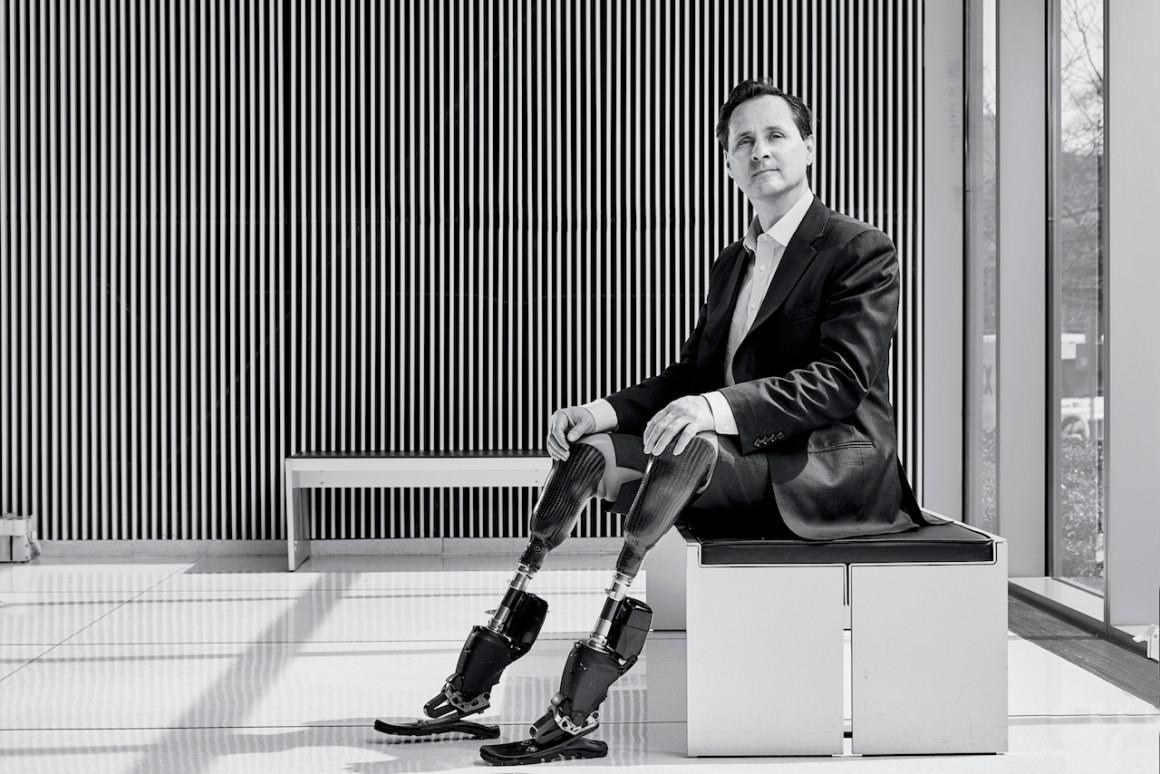
During the visit, I met Professor Hugh Herr and learned about his path into bionics. He lost both legs below the knee after a climbing accident as a teenager, and went on to develop prosthetic technologies that bring together mechanics, computation and the human body. MIT / Hugh Herr’s story
His journey made the purpose of engineering feel concrete to me. A device can change how someone moves through the world, what they can take part in, and how much control they have over everyday life.
I was especially drawn to the way his work connects disciplines. Understanding a prosthesis means thinking about the body and the person using it, as well as the mechanical design and the software that controls it.
RESEARCH CONTEXT / JULY 2025
Connecting the body and the device
A study reported by MIT shortly before my visit explored a powered bionic knee integrated with muscle and bone. Signals from remaining muscles helped control its movement, and participants reported a stronger sense that the prosthesis belonged to their body. This was a small clinical study.
Read the MIT research report02 / BODIES, BRAINS & INTERFACES
How does an intention
become an action?
The visit also introduced me to progress in brain–computer interfaces at the Media Lab. It opened up a question I want to keep exploring: how can technology connect a person’s intention with an action or experience that would otherwise be difficult to access?
The background material introduced Edward Boyden’s Synthetic Neurobiology work, including optogenetics—tools that use light to control the activity of selected neurons. Learning about these approaches showed me how closely engineering can connect with biology and neuroscience. Media Lab / Optogenetics
Different interfaces, a shared question
Brain–computer interfaces, muscle-controlled prostheses and tools for studying neurons work in different ways. What interested me across them was the relationship between a person, their nervous system and a technology they can use.
03 / FINDING MY DIRECTION
A purpose for
what I learn next.
This visit helped me decide on a direction for my future studies and research: using modern technology to help people with physical disabilities enjoy a higher quality of life.
MY DIRECTION
How can I use engineering to help people with physical disabilities have more choice, independence and enjoyment in their lives?
That goal gives my interests in mathematics, physics, biology and programming a shared purpose. I want to understand how these subjects can come together in something that makes a meaningful difference to someone’s daily experience.
It also connects with my life as a musician. Access to music, creativity and enjoyment matters alongside access to movement. My app and wearable vibration belt explore how people with hearing loss might experience organ music in another way.
Explore my music accessibility projects04 / QUESTIONS FOR MY OWN WORK
From inspiration
to engineering questions.
- How can I understand what people actually want from an assistive technology?
- What kinds of feedback make a device intuitive and comfortable to use?
- How can I evaluate an experience through the user’s own sense of access, control and enjoyment?
I’m still at the beginning of learning how to answer these questions. The Media Lab visit gave me a reason to pursue them.
Visit date and personal reflections are based on my account of the August 2025 visit. Background material: the supplied Media Lab presentation. Linked MIT sources provide context on Hugh Herr’s research and neurotechnology.